Why Do I Wake Up at 3 AM?


Have you ever found yourself staring at the ceiling at exactly 3:33 AM, your heart racing and your mind replaying a conversation from three years ago? You are not alone. For those in the helping community—educators, counselors, and administrators—this early morning wake-up call is a common, yet exhausting, experience.
In our previous exploration of what is anxiety, we defined it as an "invisible weighted vest." Today, we are looking at why that vest feels heaviest in the dark of night and how we can use neurobiology to reclaim our rest.
The Biology of the "Chemical Alarm Clock"
To understand the 3:00 AM wake-up, we must look at the Circadian Cortisol Cycle. Cortisol is our "alertness" hormone. In a regulated system, it begins a slow, natural ramp-up between 2:00 AM and 4:00 AM to prepare the body for the day ahead (Walker, 2017).
However, when an individual is carrying high levels of persistent stress, their "stress cup" is already nearly full. When that natural 3:00 AM cortisol surge hits, it "overflows the cup," triggering the body’s survival response. This chemically jolts the brain into a state of full consciousness, often accompanied by physical symptoms of dread (Russell & Lightman, 2019; Upton & Lightman, 2025).
The "Offline" Brain: Why We Catastrophize
When you wake at this hour, you are operating with a temporary neurological deficit. The prefrontal cortex—the part of the brain responsible for logic and perspective—is largely offline (LeDoux & Pine, 2016). Meanwhile, the amygdala (the emotional center) is hyper-reactive.
Without the "rational adult" part of the brain to provide balance, the amygdala amplifies minor concerns—an unreturned email, a student’s behavior, a pending deadline—into urgent, undeniable truths. In the stillness of the dark, these thoughts feel like an absolute reality because the brain lacks the resources to argue against them.
Immediate Interventions: Flipping the Switch
When the "weighted vest" of anxiety feels tight at 3:00 AM, the goal is to manually shift from the Sympathetic Nervous System (Fight-or-Flight) to the Parasympathetic Nervous System (Rest-and-Digest).
1. The 4-4-4-4 Box Breathing Method

Popularized by Navy SEAL Commander Mark Divine, this technique is a biological "hack" for the Vagus Nerve. By equalizing your breath, you signal to the brain that there is no immediate threat, effectively lowering your heart rate and cortisol production.
Inhale for 4 seconds.
Hold for 4 seconds.
Exhale for 4 seconds.
Hold for 4 seconds.
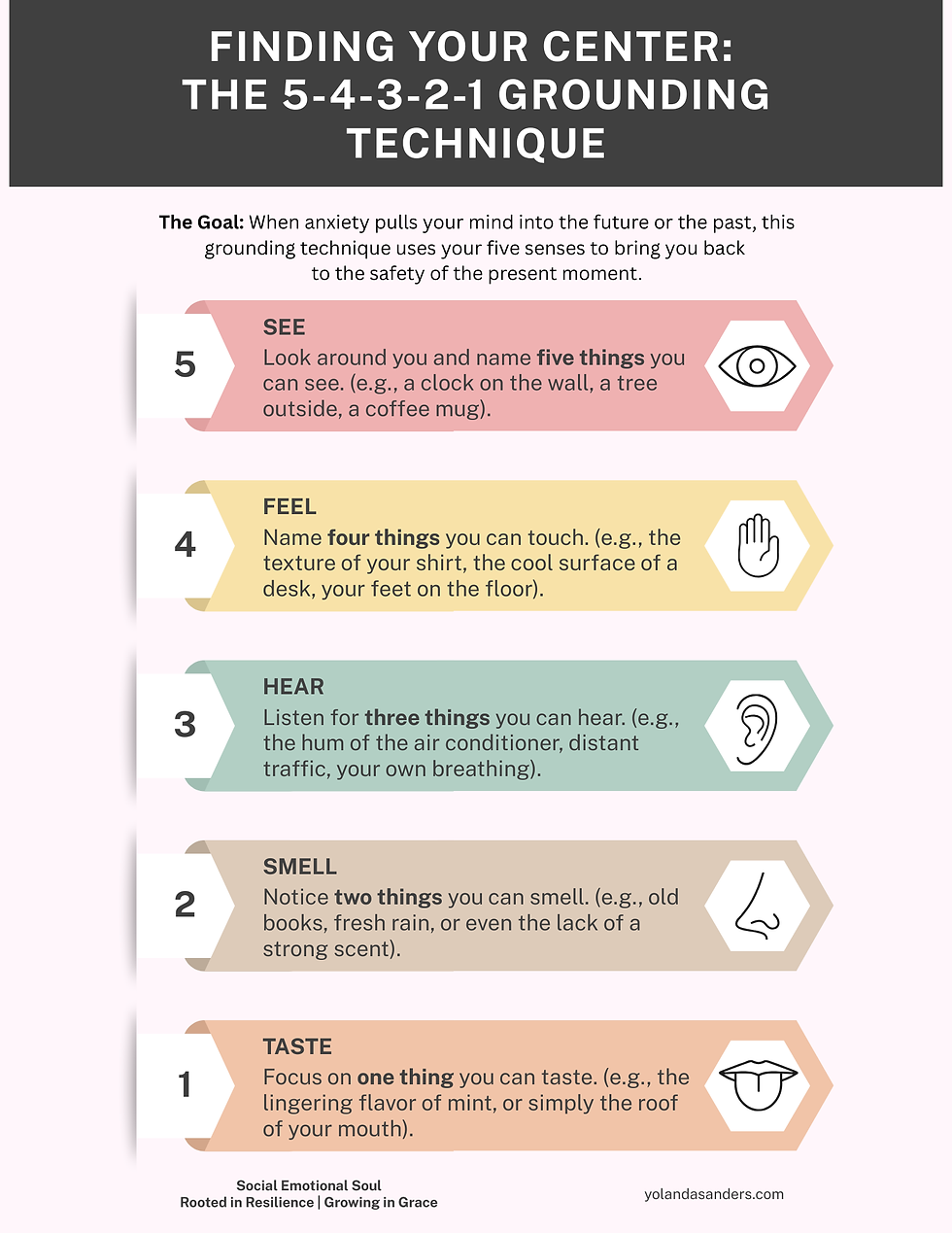
If your mind is caught in a worry loop, grounding forces the brain to switch from internal "threat monitoring" to external "sensory processing" (Barlow, 2004). Here is how the 5,4,3,2,1 technique works: identify 5 things you see, 4 you feel, 3 you hear, 2 you smell, and 1 you taste.
Long-Term Healing: Beyond the "Band-Aid"
While breathing and grounding help in the moment, stopping the phenomenon requires addressing the "stuck" survival energy in the nervous system.
EMDR: Processing the Alarm
Eye Movement Desensitization and Reprocessing (EMDR) helps move distressing "worry loops" from the reactive emotional center to long-term storage (Shapiro, 2017). By targeting the physical sensations or the core beliefs (e.g., "I am out of control") associated with the 3:00 AM wake-up, EMDR can "lower the volume" of the physiological alarm.
Somatic Experiencing: Releasing the "Freeze"
Somatic Experiencing (SE) focuses on how the body traps survival energy. When we "power through" a high-stress day, that energy stays locked in our tissues. SE helps the body "discharge" this tension through small, manageable steps—a process known as titration (Levine, 2010). This prevents the "weighted vest" from becoming a permanent fixture of our physiology.
A Path Toward Prevention
To prevent the 3:00 AM surge from overflowing your cup, consider these proactive steps:
The Brain Dump: Offload your amygdala by writing down every "to-do" item two hours before bed.
Blood Sugar Stability: A small, protein-rich snack before bed can prevent a hypoglycemic cortisol spike.
Label the Experience: Remind yourself, "This is a cortisol spike, not a life crisis."
Soul Lesson: Your body is not a suitcase to be packed tight with the world’s worries; it is a river meant to flow. Peace is not the absence of the surge; it is the rhythm you find within it.
Rooted in Resilience | Growing in Grace
References
Barlow, D. H. (2004). Anxiety and its disorders: The nature and treatment of anxiety and panic. Guilford Press.
LeDoux, J. E., & Pine, D. S. (2016). Using neuroscience to help understand fear and anxiety. American Journal of Psychiatry.
Levine, P. A. (2010). In an unspoken voice: How the body releases trauma and restores goodness. North Atlantic Books.
Russell, G., & Lightman, S. (2019). The human stress response. Nature Reviews Endocrinology.
Shapiro, F. (2017). Eye Movement Desensitization and Reprocessing (EMDR) Therapy. Guilford Press.
Walker, M. (2017). Why we sleep: Unlocking the power of sleep and dreams. Scribner.


Comments