Understanding the Invisible Weighted Vest: What is Anxiety and How Do I Know If I Have It?

Updated: Mar 28

We have all felt that sudden tightening in the chest before a major presentation, the restless pacing before a difficult conversation, or the "butterflies" that feel more like a swarm of hornets when facing the unknown. As a former classroom teacher and school administrator, I have seen these physical and emotional responses in students, staff, and—if I’m being honest—in myself. Now, as a mental health counselor, I look back at those moments through a different lens.
Anxiety is one of the most common human experiences, yet it remains one of the most misunderstood. It is often dismissed as "just stress" or, conversely, feared as an uncontrollable monster. To navigate it, we must first define what it is, distinguish it from the normal stresses of life, and identify the markers that suggest it might be time to seek professional support.
What is Anxiety?
At its core, anxiety is the body’s natural response to stress. It is a feeling of fear or apprehension about what is to come. Evolutionarily, anxiety served a vital purpose: it was the biological "alarm system" that kept our ancestors alert to predators (Barlow, 2004). When the brain perceives a threat, it triggers the autonomic nervous system, specifically the "fight-or-flight" response.
However, in the modern world, our "predators" are rarely saber-toothed cats. Instead, they are deadlines, social evaluations, financial pressures, or global uncertainties. While the threats have changed, our physiological response has stayed the same (LeDoux & Pine, 2016).
The Difference Between Stress and Anxiety
It is helpful to view stress and anxiety as cousins, but not twins.
Stress is typically triggered by an external factor. Once the situation is resolved, the stress usually dissipates.
Anxiety is internal. It is defined by persistent, excessive worries that don't go away even in the absence of an immediate stressor (American Psychiatric Association [APA], 2022). It is the "what if" that lingers long after the "what is" has been handled.
The Spectrum of Anxiety: From Normal to Clinical
Anxiety exists on a spectrum. On one end, you have Low-Level Anxiety, which can be motivating. On the other end is Clinical Anxiety, which occurs when the alarm system gets "stuck" in the "on" position.
When we talk about clinical anxiety, we refer to various disorders categorized by the Diagnostic and Statistical Manual of Mental Disorders (APA, 2022). These include:
Generalized Anxiety Disorder (GAD): Chronic, exaggerated worrying about everyday life.
Social Anxiety Disorder: An intense fear of being judged or rejected in social situations (Hofmann & Bitran, 2007).
Panic Disorder: Characterized by sudden, intense episodes of fear accompanied by physical symptoms.
Specific Phobias: Intense, irrational fear of a specific object or situation.
How Do I Know if I Have It?
Knowing if you "have" anxiety involves looking at the frequency, intensity, and duration of your symptoms. During my time as an instructional coach and district leader, I noticed that many high-achieving professionals mask their anxiety as "productivity" or "perfectionism."
However, as noted by trauma expert Bessel van der Kolk (2014), the body keeps the score. Even when we mentally push through a stressful day or a difficult board meeting, our nervous system stores that tension, which manifests as physical symptoms that cannot be ignored. The body eventually demands the attention that the mind tries to defer. Below are some core indicators.
1. The Physical Manifestations
Anxiety is a full-body experience. Because the brain thinks it is under attack, it redirects resources to your muscles and heart (LeDoux & Pine, 2016).
Cardiovascular Strain: You may experience an increased heart rate, palpitations, or chest tightness.
Gastrointestinal Distress: The "brain-gut axis" is highly sensitive to anxiety. You might feel nausea or "butterflies" as digestion slows down (Van der Kolk, 2014).
Respiratory Changes: Shortness of breath or rapid breathing (hyperventilation) can occur.
Neurological Sensations: Dizziness, lightheadedness, or physical tremors are common. Some describe a "buzzing" or "electric" sensation under the skin—this is the nervous system firing at a high frequency as it scans for perceived threats.
2. Cognitive and Emotional Symptoms
This involves thought patterns that keep the cycle of fear moving (Barlow, 2004).
Rumination: Thinking about the same problem over and over without reaching a solution (Hofmann & Bitran, 2007).
Catastrophizing: Automatically assuming the worst-case scenario. In a leadership context, this looks like assuming one minor error will lead to professional ruin.
Irritability: Feeling "on edge." Often, what looks like anger is actually a nervous system that is over-stimulated (LeDoux & Pine, 2016).
Brain Fog: Difficulty concentrating. When the amygdala is overactive, the prefrontal cortex often goes offline to prioritize survival (Walker, 2017).
3. Behavioral Changes: The Power of Avoidance
The most common behavioral symptom of anxiety is avoidance. While it provides short-term relief, it creates a "shrinking world" where you stop taking risks or engaging in social energy (APA, 2022; Barlow, 2004).
The 3:00 AM Phenomenon: Why Anxiety Wakes Us in the Dark
One of the most frequent reports I hear from clients—and one I recognized often in my leadership roles—is the "3 AM wake-up call."
The Cortisol Spike
Our bodies follow a circadian rhythm governed by hormones. In the early morning hours, typically between 2:00 AM and 4:00 AM, the body begins its natural process of ramping up cortisol (the "alertness" hormone) to prepare the cardiovascular system for wakefulness (Russell & Lightman, 2019; Upton & Lightman, 2025). For a person with a regulated nervous system, this rise is gradual. However, for those living with persistent stress, the natural 3 AM cortisol surge "overflows the cup," triggering a fight-or-flight response that jolts you into consciousness (Upton & Lightman, 2025).
The "Offline" Brain
During these early morning hours, the prefrontal cortex—the part of the brain responsible for logic, executive function, and rationalizing—is largely offline (LeDoux & Pine, 2016). Meanwhile, the amygdala (the emotional center) remains hyper-reactive. Without the rational "adult" part of the brain to provide perspective, the amygdala amplifies even minor concerns into urgent, undeniable truths that feel far more significant in the stillness of the dark (Russell & Lightman, 2019; Upton & Lightman, 2025).

High-Functioning Anxiety
While not a formal diagnosis, High-Functioning Anxiety describes individuals who appear successful while struggling internally (Hofmann & Bitran, 2007). This often manifests as overachieving or an inability to say "no" out of fear of being seen as incompetent.
Why Me? Understanding the Roots
If you find yourself struggling with these symptoms, it is important to know that it isn't a "flaw" in your character. Anxiety is a complex intersection of several factors:
Genetics: A family history of anxiety can increase your biological predisposition (APA, 2022).
Brain Chemistry: Imbalances in neurotransmitters like serotonin and dopamine play a significant role in how we process fear (LeDoux & Pine, 2016).
Environment and Trauma: Significant life changes or the chronic, grinding stress of a demanding career can trigger onset. For those in the helping community, the secondary traumatic stress we absorb can also be a catalyst (Van der Kolk, 2014).
Professional Support: When is it Time?
Consider reaching out to a professional if:
Interference: It hinders work, relationships, or self-care (APA, 2022).
Distress: The emotional pain feels unmanageable (Barlow, 2004).
Duration: Symptoms persist most days for six months or longer (APA, 2022).
Physical Health: It causes chronic migraines or digestive issues (Van der Kolk, 2014).
The Path Forward: Strategies for Managing the Noise
As a lifelong learner and counselor, I advocate for a multi-modal approach to anxiety. We cannot simply "think" our way out of a physiological response, but we can train our nervous system to find its way back to calm.
1. Grounding Techniques
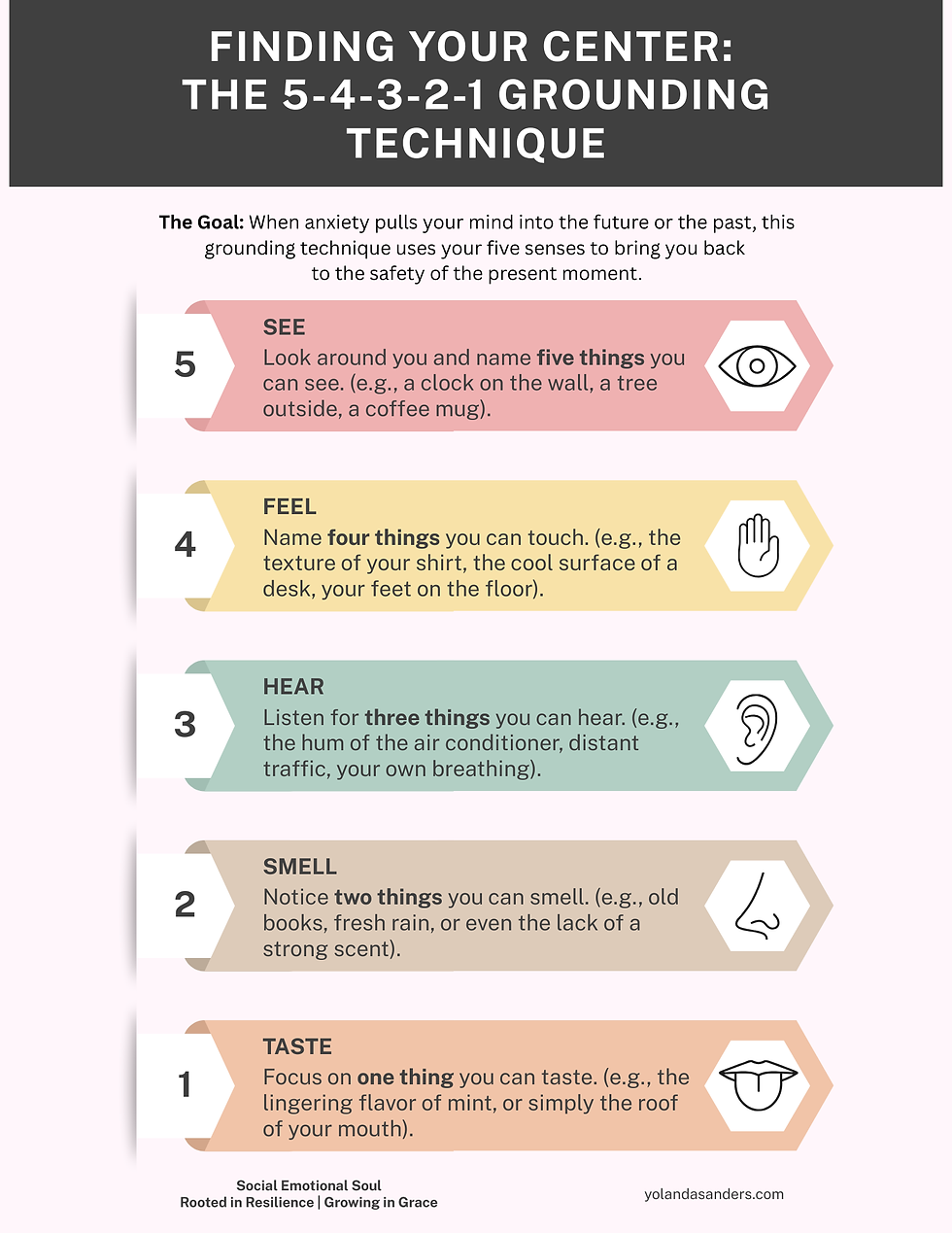
When you are in the middle of an anxious spiral, you need to "come back" to your body. The 5-4-3-2-1 Technique is a favorite in both classrooms and therapy offices because it forces the brain to switch from internal "threat monitoring" to external "sensory processing."
2. Cognitive Reframing
This involves identifying "cognitive distortions"—those lies the brain tells us when it’s scared. Instead of asking, "What if I fail?" try asking, "What if I succeed?" or "If the worst happens, do I have the tools to handle it?" Reframing isn't about "toxic positivity"; it's about accuracy. Is the threat truly as large as your brain is making it out to be?
3. Nervous System Regulation
Since anxiety is a physiological event, we must use physiological tools. Deep Diaphragmatic Breathing or Box Breathing signals to the vagus nerve that the body is safe, effectively "braking" the fight-or-flight response.
4. Medication
In some cases, medication managed by a psychiatrist or a primary care physician can help lower the "baseline" of anxiety. Think of it as lowering the volume on a loud radio so you can finally hear the therapist’s voice and do the work of healing.
Soul Lesson
Anxiety is not your identity; it is a signal from a heart that cares deeply about the world. Listen to the signal, acknowledge the fear, but do not let it drive the car.
Rooted in Resilience | Growing in Grace
References
American Psychiatric Association. (2022). Diagnostic and statistical manual of mental disorders (5th ed., text rev.). https://doi.org/10.1176/appi.books.9780890425787
Barlow, D. H. (2004). Anxiety and its disorders: The nature and treatment of anxiety and panic (2nd ed.). Guilford Press.
Hofmann, S. G., & Bitran, S. (2007). Sensory-processing sensitivity and social anxiety disorder. Depression and Anxiety, 24(1), 9–13. https://doi.org/10.1002/da.20213
LeDoux, J. E., & Pine, D. S. (2016). Using neuroscience to help understand fear and anxiety: A two-system framework. American Journal of Psychiatry, 173(11), 1083–1093. https://doi.org/10.1176/appi.ajp.2016.16030353
Russell, G., & Lightman, S. (2019). The human stress response. Nature Reviews Endocrinology, 15(9), 525–534. https://doi.org/10.1038/s41574-019-0228-0
Upton, T. J., & Lightman, S. L. (2025). Waking and stress: Cortisol dynamics in the transition from sleep to wakefulness. Proceedings of the Royal Society B: Biological Sciences, 292(2024.01).
Van der Kolk, B. A. (2014). The body keeps the score: Brain, mind, and body in the healing of trauma. Viking.
Walker, M. (2017). Why we sleep: Unlocking the power of sleep and dreams. Simon & Schuster.


Comments