Building Resilience Through Failure: What a Missing Puzzle Piece Teaches Us About Life


There is a specific, quiet agony in reaching the end of a 1,000-piece jigsaw puzzle only to realize the final space on the board remains empty. You’ve spent hours, perhaps days, sorting by color, defining the edges, and navigating the "false fits" of the sky or the sea. You have leaned into the process with discipline and hope. Yet, there it is: a jagged, cardboard void. In that moment, the initial impulse is rarely one of philosophical reflection. Usually, it is a mixture of frustration, a sense of incompleteness, and perhaps the urge to check under the rug one last time.
However, if we sit with that void long enough, the missing piece begins to transform from a domestic nuisance into a profound metaphor for the human experience. In our personal and professional lives, we often equate "success" with the completed picture—the degree earned, the promotion secured, or the relationship that finally feels "settled." We view failure as the missing piece, the gap that ruins the aesthetic of our efforts. But what if the gap isn't a defect? What if the "failure" to complete the picture exactly as planned is actually the primary mechanism through which we build resilience?
The Architecture to Build Resilience
Resilience is frequently misunderstood as a static quality—something one either possesses or lacks, like eye color. In reality, resilience is a dynamic process of adaptation (American Psychological Association [APA], 2020). It is the psychological equivalent of muscle hypertrophy; just as muscle fibers must experience microscopic tears to grow stronger, our emotional and cognitive frameworks must encounter resistance to expand.
In the context of the helping professions—whether as educators, mental health counselors, or leaders—we often operate under the "perfectionist’s burden." We feel that to guide others, our own puzzles must be perfectly assembled. Yet, the most impactful growth occurs not when the pieces fit perfectly, but when we are forced to reconcile with the gaps. Failure provides a unique form of data that success cannot offer. It forces a recalibration of strategy, a deepening of patience, and a shift in perspective from the "outcome" to the "on-going" (Southwick & Charney, 2018).
The Missing Piece as a Catalyst for a Growth Mindset

To understand how a missing puzzle piece builds resilience, we must examine the cognitive framework we bring to the table. In my work as an educator and a mental health counselor, I frequently witness the dichotomy between a fixed mindset and a growth mindset. When someone with a fixed mindset encounters the "gap" of a missing piece—or a perceived failure in their career or personal life—they often interpret it as a personal indictment. They believe their abilities are static; therefore, a hole in the puzzle means they are fundamentally lacking.
Conversely, a growth mindset, a concept pioneered by Carol Dweck (Dweck, 2006), allows us to view challenges not as a final judgment on our competence, but as a necessary part of the learning process. In this framework, the missing piece is not a tragedy; it is an invitation to curiosity. It asks us: What can I learn from the 999 pieces I did find? How did I manage the complexity of the task thus far?
Reconditioning the Professional Self
For those of us in the helping community—who have perhaps transitioned from the classroom to instructional coaching or into administrative roles—the pressure to "know the answer" is immense. We are often trained to be the providers of the missing pieces for others. However, adopting a growth mindset means acknowledging that we, too, are works in progress.
When a program we manage doesn't meet its metrics, or a therapeutic intervention doesn't yield the expected breakthrough, the growth mindset shifts the internal dialogue from "I am not a good leader" to "This specific strategy requires refinement" (Dweck, 2006). This shift is the hallmark of the "Social Emotional Soul." It bridges the gap between our high professional standards and the messy, unpredictable reality of human systems. By embracing the "not yet" rather than the "never," we model for our students, clients, and direct reports that the value of the journey is never diminished by an incomplete destination.
Embracing the "Incomplete" Picture
When we encounter a missing piece in life, our first instinct is often to discard the entire project. We think, If it’s not perfect, it’s not worth it. This "all-or-nothing" cognitive distortion is a significant barrier to resilience. Building a "Social Emotional Soul" requires us to value the 999 pieces currently on the board rather than obsessing over the one that is gone.
In a classroom or a clinical setting, we see this often. A student fails a high-stakes exam, or a client experiences a setback after weeks of progress. If we frame these moments as total failures, we reinforce fragility. If, however, we look at the puzzle and realize that the image is still visible, recognizable, and beautiful despite the gap, we foster resilience. We learn that we can function, thrive, and contribute even when life feels incomplete. This "ordinary magic" of adaptation is what allows us to bounce back from adversity (Masten, 2014).
Practical Strategies for Reframing Failure
As we navigate the inevitable gaps in our personal and professional lives, we must move beyond the theoretical understanding of resilience and into the realm of actionable practice. For the educator in a classroom of thirty diverse learners, or the therapist holding space for a client’s deepest trauma, the "missing piece" can feel like a crisis of competence. To bridge this gap, we can utilize specific, evidence-based strategies to recondition our response to failure.
1. The "Three-Column" Cognitive Reframe
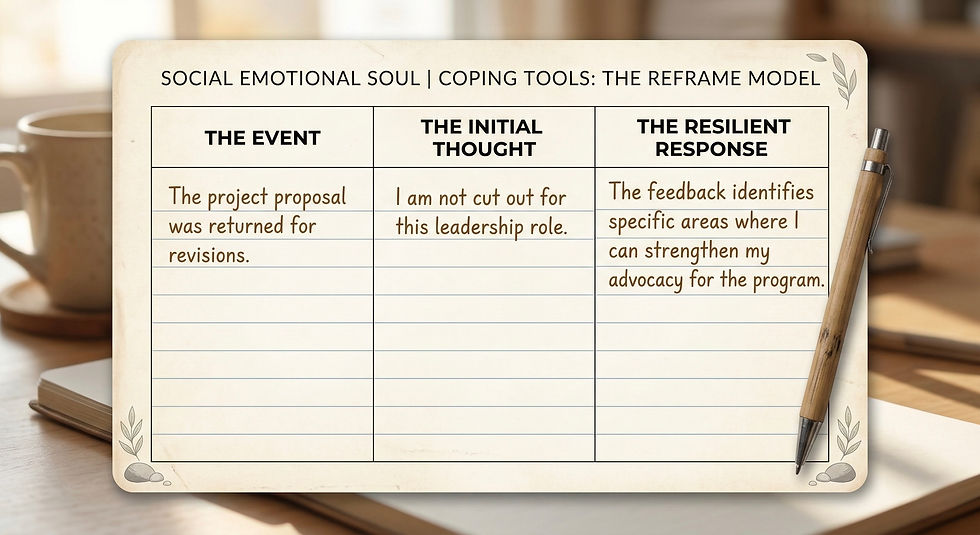
One of the most effective tools used in cognitive behavioral approaches is the systematic reframing of negative self-talk. When you identify a "missing piece" in your work, create three columns on a sheet of paper:
Column A (The Event): State the fact without judgment (e.g., "The project proposal was returned for revisions").
Column B (The Initial Thought): Record the automatic negative thought (e.g., "I am not cut out for this leadership role").
Column C (The Resilient Response): Challenge the thought with a growth-oriented perspective (e.g., "The feedback identifies specific areas where I can strengthen my advocacy for the program").
This exercise forces the brain to move from the emotional center (the amygdala) to the rational center (the prefrontal cortex), allowing for a more measured and resilient response to setbacks (Southwick & Charney, 2018).
2. Radical Acceptance of the Void
In mental health counseling, we often discuss the concept of radical acceptance—accepting reality as it is, without trying to fight it or judge it. In our puzzle metaphor, this means looking at the empty space and saying, "The piece is missing, and I can still find value in the 999 pieces I have placed." Radical acceptance does not mean approval; it means acknowledging the "is-ness" of the situation so that you can move forward instead of being paralyzed by what should have been.
3. Searching for "False Fits"
In jigsaw puzzles, a "false fit" occurs when two pieces seem to click together but don't actually belong. In life, we often force "false fits" by trying to make a career path, a relationship, or a specific goal work when it simply doesn't align with our values or the reality of the situation. Resilience involves the wisdom to recognize a false fit and the courage to pull the pieces apart to try a different configuration. This iterative process is how we develop "ordinary magic"—the everyday capacity to adapt and overcome (Masten, 2014).
The Role of Compassionate Leadership

As a former districtwide school leader and program manager, I have seen firsthand how the culture of an organization dictates how failure is handled. If we lead from a place of fear, we teach our staff to hide their missing pieces. This leads to burnout, disconnection, and a lack of innovation.
However, if we lead with a "Social Emotional Soul," we create an environment where the "gap" is seen as a data point rather than a deficiency.
When we share our own stories of professional setbacks—the instructional coach who struggled to connect with a veteran teacher, or the administrator who had to pivot a school-wide initiative mid-year—we humanize the process of growth. We show that leadership is not about having a complete puzzle at all times; it is about the resilience to keep sorting through the pieces even when the outcome is uncertain (APA, 2020).
Conclusion
The next time you find yourself staring at a gap in your life’s work, resist the urge to sweep the pieces onto the floor. The missing piece isn't a sign that you've failed; it is an invitation to see the beauty in what remains. Resilience isn't about finding every piece; it's about being okay with the space that's left behind, knowing that you are still whole without it.
Soul Lesson: True resilience is found not in the perfection of the finished product, but in the grace we afford ourselves when the final piece is nowhere to be found.
Rooted in Resilience | Growing in Grace
References
American Psychological Association. (2020). Building your resilience. http://www.apa.org/topics/resilience
Dweck, C. S. (2006). Mindset: The new psychology of success. Random House.
Masten, A. S. (2014). Ordinary magic: Resilience in development. Guilford Press.
Southwick, S. M., & Charney, D. S. (2018). Resilience: The science of mastering life's greatest challenges (2nd ed.). Cambridge University Press.

Comments